Showing posts with label Dublin. Show all posts

Wednesday, 17 April 2024

The first tank in Ireland - November 1917

While a number of improvised armoured cars were constructed during the Easter Rising using lorries from Guinness and steel plate from the Inchicore rail works, and several Rolls-Royce armoured cars arrived in Ireland just after the Rising, tanks were still too new (and secret) to make an appearance in Ireland. The arrival of the 17th (Armoured Car) Battalion of the Tank Corps in January 1919 is reasonably well documented/photographed with a mixture of Mark IV, Mark V* and Whippet tanks and Austin armoured cars.

In November 1917, however, a Mark IV tank appears to have been in Dublin operating at the RDS in Ballsbridge while a host of other Mark IV tanks were preparing for the Battle of Cambrai (and two for the Lord Mayor's Show in London). There is some irony here as County Dublin born Walter Wilson was heavily involved in the design work.

There was a reference to a tank in Dublin pre 1919 mentioned on a thread on the Great War Forum many years ago and a reference to this being filmed in the blog on Early Irish Cinema (and to cameraman John Gordon Lewis) by Denis Condon (@DenisCondon on Twitter) :

https://earlyirishcinema.com/category/films/topicals/tanks-in-dublin-ireland-gfs-1917/


The Freeman's Journal carried a news item that month re the film that Lewis had taken  :


The head on image is blurry but the number 42 can be made out on the front slope of the tank. Not standard number format for the tanks and not quite sure what it means.


Lewis's offices were raided by anti-treaty Republicans and it was believed that his film of the event was lost. A visit to the National Archives in Dublin re the file containing Lewis's claim for damage didn't reveal any more information sadly.


However, a post on Twitter by @ThisDayInWWI with a video of a tank looked familiar. Sure enough, the number 42 appears on the front of the tank, the head on view matches the image from the Freeman's Journal, and there appear to be horses in the background (the RDS in the Ballsbridge area of Dublin being used as a staging point for horses going to the Army).

The film is hosted on the Imperial War Museum (IWM) website (catalogue number IWM 1196) and carries the somewhat unhelpful title :

"TANKS MARK IV, SCHNEIDER, AND MARK IV UNDITCHING [Allocated Title]"

https://www.iwm.org.uk/collections/item/object/1060000185


The film is made up of a number of different clips. The one related to Lewis's filming runs from 00:00 to 02:55 so not a lot of footage but enough to spark interest (and possibly meaning that there is more out there somewhere - e.g. the top photo in the Journal article doesn't match in the clip).


Tank 42 appears in this second clip on the IWM site (catalogue number IWM 1198) from about 11:15. The background from 11:22 looks to be the same as the above clip so possibly the RDS too

https://www.iwm.org.uk/collections/item/object/1060000187


It would appear that there was concern in England that trouble was brewing in Ireland following the death of Thomas Ashe, the Sinn Fein Convention etc and that 4 tanks in a Special Service Unit were sent across from Bovington as a potential show of force - 2 kept in Dublin, 1 sent to Cork, 1 sent to Limerick. (Updated 20th October 2024). Captain Dinnen Burns Gilmore's account of being among the unit and with the tank sent to Limerick is available to view in the Tank Museum Archive at Bovington.

As well as having the first tank in Dublin in November 1917, the first Tank Corps death happened too.

Captain Leonard Bates MC was killed while a tank was being unloaded at the RDS in Ballsbridge, Dublin.


Present at the inquest were 2 members of the Tank Corps :


Sgt William Quincey Jeffs appears to have been a Sergeant instructor while Lt Thomas Frederick Murphy appears to have been a wounded officer recovering from burns.  Murphy and Bates had both been commissioned into the Machine Gun Corps from the 18th (Service) Battalion, Royal Fusiliers in early 1916, both having qualified as machine gunners.


Captain Bates is buried in Grangegorman Cemetery in Dublin.

https://www.cwgc.org/find-records/find-war-dead/casualty-details/899811/leonard-john-bates/


Clips from the film appear in other films on the IWM site :

The US troops section of the film is labelled 356-2 and this can be seen in the Topical Budget 356-2 film on the IWM site (catalogue number NTB 356-2) at approx 3:47 on the timeline :

https://www.iwm.org.uk/collections/item/object/1060005457


Several of the clips appear in the film on the IWM site (catalogue number IWM 337) titled "Tanks The Wonder Weapon" :

https://www.iwm.org.uk/collections/item/object/1060022815


Links to previous related posts :

John Gordon Lewis


Guinness Lorries

Guinness Lorry Drivers

Henry Deasy (and armouring the Guinness lorries)

Colonel Allatt

Colonel Portal


17th (Armoured Car) Battalion, Tank Corps

Victory Parade Dublin July 1919


Monday, 9 May 2022

2nd (Garrison) Battalion, Royal Irish Regiment

 Formed in Dublin in March 1916, there doesn't appear to be too much information regarding 2nd (Garrison) Battalion, Royal Irish Regiment. It appears to have been designated for Home Service.

The Long, Long Trail website indicates it remained in Dublin until April 1918 where it's name was changed and it went to France

https://www.longlongtrail.co.uk/army/regiments-and-corps/the-british-infantry-regiments-of-1914-1918/royal-irish-regiment/


Soldiers started joining the unit on the 11th March 1916 with a cadre of NCOs and soldiers, numbers being assigned with 2G/ as the prefix. Number 2G/1 went to CSM Arthur Marshall, a Londoner born on 29th April 1967, who joined from the Royal Irish Rifles. Most of the names listed below appear to have joined from the Royal Irih Rifles.


NoRankForenameSurname
2G/1CSMArthur WoodriffeMarshall
2G/4RSMJosephSullivan
2G/7CQMSRobertGamble
2G/8SgtPatrick JosephHouston
2G/16CplRichardWaide
2G/17WilliamNeill
2G/18L/SgtJohnCrossley
2G/21A/CplCharlesGraham
2G/22L/SgtWilliam RichardYoung
2G/44PtePatrickCarroll
2G/47PteRobertDoyle
2G/51PteWilliamDavis
2G/60PteRobertFlaherty
2G/73PteWilliamHughes


2G/7 CQMS Robert Gamble was a Dubliner. Killed during the Easter Rising near Beggar's Bush Barracks on the railway line.

We can assume that most of the above were in Dublin at the time of the Rising, though the Battalion is not listed in the various books that give details of the units present on 24th April.

Privates Waters and Flynn mentioned as injured/killed at the Magazine Fort do not appear to have been assigned 2G/ numbers. 

Henry Agnew appeard to have joined the unit on the 15th April and assigned the number 2G/646.

2G/646
HenryAgnew

It does raise the question of how many men of this unit were in Dublin at the time of the Rising, what were they doing on Day 1 and what did they do on subsequent days. Were there others like Flynn and Waters who did not have 2G/ numbers.

The unit Commanding Officer appears to have been Lt. Colonel Sir Frederick W. Shaw, D.S.O. who made his way to Beggar's Bush Barracks at the start of the Rising (he had been in command of the Ulster Volunteer Force aligned 2nd Bn, Loyal Dublin Volunteers in the run up to WW1).

2nd Lt Edward Gerrard, Royal Field Artillery, arrived in Beggar's Bush Barracks on the 24th April and noted that 2nd (Garrison) Bn, Royal Irish Regiment men were there :

one or two ranker officers (promoted from the ranks)
4 NCO's
10 men (including 3 invalids)

I had read somewhere about the unit possibly being at Richmond Barracks - possibly in conjunction with the research on Flynn and Waters or re the death of 2G/213 Pte James Cavanagh, from Co Monaghan, who looks to have been killed in the South Dublin Union area (another former Royal Irish Rifles soldier)

https://www.cwgc.org/find-records/find-war-dead/casualty-details/899910/james-cavanagh/

The UK Soldiers Died in the Great War has Cavanagh as died in Gallipoli. More likely he was wounded in Gallipoli and that was the reason for his transfer in Dublin.


Officers identified as being with the Battalion at some stage are :

RankForenameSurname
CaptainThomasPowell
CaptainEdward Francis NathanielBurton
LtMorgan
CaptainF RRobinson

A few details of their service but nothing re role in the Rising yet.


The 2nd Garrison Battalion, Royal Irish Fusiliers was also formed in Dublin around April 1916. This appears to have not been for Home Service - moved to Templemore in May 1916 and then sent overseas.

Private Joseph Cullen from this unit appears to have been killed in Dublin on the 25th April 1916

https://www.cwgc.org/find-records/find-war-dead/casualty-details/899969/joseph-cullen/


He appears to have been a pre-war soldier and entered France on 8th October 1914 with 2nd Royal Irish Rifles, number 4550.

Sunday, 8 May 2022

Magazine Fort Casualties, Royal Irish Regiment

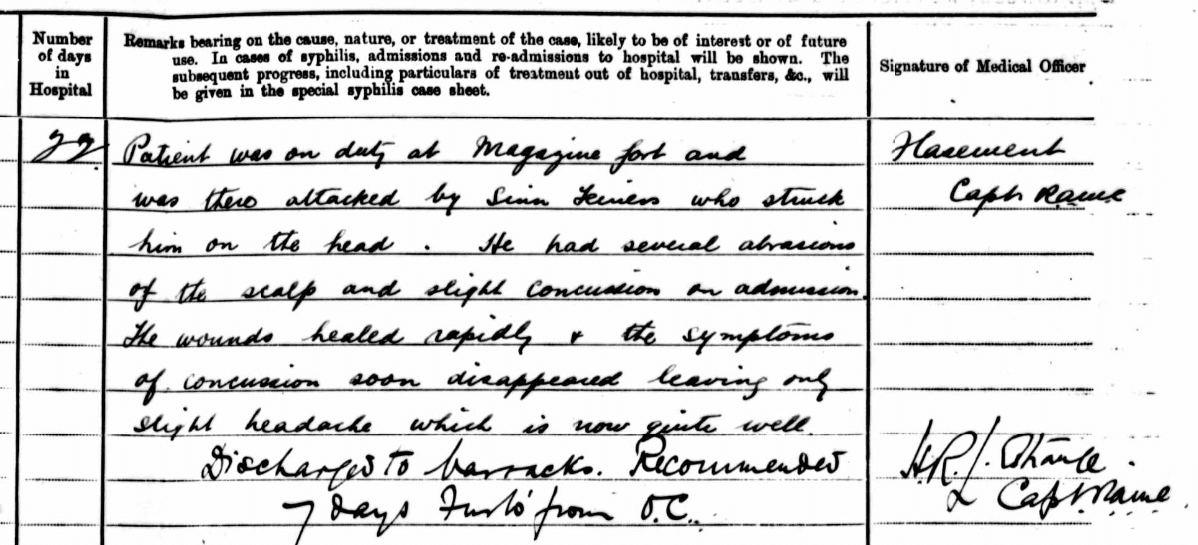
 During the attack on the Magazine Fort on the opening day of the Rising, Monday 24th April 1916,  the sentry at the gate was overpowered without shots being fired.

This looks to have been Private John Waters, no 9901, 2nd (Garrison) Battalion, Royal Irish Regiment.

His service records mentions the attack and notes his time in hospital.


He appears in a newspaper Roll of Honour from May 1916 but does not appear in the 1916 Rebellion Handbook among the list of wounded from the Royal Irish Regiment.


He appears to have joined up while in a spot of bother in Co Wexford (he had previous service in the Royal Navy so a surprise that he joined the Army)


He was discharged from the Army in June 1916 so may have had to face the above prosecution.


His number, 9901, does not appear to have been issued by the newly formed 2nd (Garrison) Battalion.

The attack happened on his birthday, 24th April. He was born 24th April 1876 in Duncannon, the son of John and Mary Waters.

https://civilrecords.irishgenealogy.ie/churchrecords/images/birth_returns/births_1876/03053/2119472.pdf


Inside the Magazine Fort, one sentry was shot in the leg.


This looks to have been Private John Flynn, no 8786, 2nd (Garrison) Battalion, Royal Irish Regiment. This number does not appear to be one issued by the 2nd (Garrison) Battalion.

Flynn died in June 1916 as a result of an issue with his femoral artery.


The Edward Quinn who appears a few lines down from Flynn is my Gt Gt Grandfather. This was an unexpected find while researching Flynn.

Flynn appears to have tried to enlist in the Army in 1915 but discharged as not likely to make an efficient soldier. He had a wife and a rake of kids sadly.


In the 1916 rebellion Handbook, Flynn appears in the list of Royal Irish Regiment soldiers killed and he is noted as being from Carrick on Suir. He is buried in Kilkenny

https://www.cwgc.org/find-records/find-war-dead/casualty-details/663032/john-flynn/


Sunday, 14 February 2016

Easter Rising Mastermind

Forwarded the following link to a video re Mastermind questions re the "Easter Rising"

http://www.joe.ie/movies-tv/video-this-mans-bbc-mastermind-specialist-subject-is-the-easter-rising-can-you-beat-his-score/530872

Great that the Easter Rising appears as a topic but the questions are just so basic (and the first question is way too long for a simple answer that anyone with a basic grasp of the Rising should know let alone someone with specialist knowledge)

Here are some slightly harder questions to get the brain cells going :

1. What organisation links a ship involved in the Easter Rising with the current location of the Irish Embassy in London?

2. The standard rifle of the British Army in WW1 was the .303 SMLE. Some members of the 2nd line battalions of the Notts and Derby Regiment were trained with what unusual rifle?

3. Who were known as the Gorgeous Wrecks?

4. Which organization owned the HMY Helga (which shelled parts of Dublin) and the farm in County Galway which was shelled by HMS Laburnum?

5. Which medal has been awarded to both Sir Roger Casement and to Robert Monteith long before they were landed on the Kerry coast?

6. Who was the most senior British officer to die as a result of the Easter Rising?

7. From which county in Ireland was the Canadian soldier killed in the Rising from?

8. Which author "did good work" as a stretcher bearer during the Easter Rising?

9. Which British ship picked up the wireless messages sent by the Irish Volunteers announcing the establishment of an Irish Republic?

10. Name the actors from opposing sides from the Rising who played roles in the Hollywood film "How Green Was My Valley"?

11. Name an "American" citizen involved in the Rising on the Rebel side (easy), a civilian casualty (harder), a participant in the British Army (mentioned in a previous blog post).

12. Name the Chief Secretary of Ireland at the time of the Rising.

13. How was Norway "involved" in the Easter Rising? (several possible answers; be creative)

14. Which town was shelled by the German Navy in an operation supporting the Rising?

15. Name 3 of the people murdered by Captain Bowen-Colthurst other than Francis Sheehy Skeffington.

16. How many British officers and Guinness employees were executed by members of the Royal Dublin Fusiliers in the Guinness works?

17. Name the Irish judge involved in the Easter Rising who wrote "The Pals at Suvla Bay" re the 7th Bn Royal Dublin Fusiliers at Gallipoli.

18. Which British General spoke very highly of Patrick Pearse having met Pearse at his court martial?
"I have just done one of the hardest tasks I have ever had to do. I have had to condemn to death one of the finest characters I have ever come across"

19. Which British officer killed in the Easter Rising is buried in the same grave in Glasnevin as his brother who fought with the Irish Volunteers?

20. St Stephen's Green saw truces to allow the park keeper to feed the ducks. Which British officer involved in the Rising wrote about wild ducks and how to rear and shoot them?

21. Who was "James E Landy"/"Mr Hammond"?

22. Chalk and Granite were used for what during the run up to the Easter Rising?

23. Following the Easter Rising, Irish rebels were held where in North Wales?

24. Where was Room 40?

25. Name the 2 civilian women who were awarded the Military Medal as a result of their helping the wounded whilst under fire.

26. What was Michael Collin's role during the Easter Rising?

27. Who allegedly declared himself to be a Sinn Feiner "from the backbone out"?

28. Who helped wind the clock?

29. Who was James Connolly's secretary?

30. Which priest stayed with the rebels in the GPO?

31. On what date were most Irish prisoners in released in 1916?

32. Name a winner of the Sigerson Cup who fought in the GPO?

33. Why was Liberty Hall not destroyed by the artillery shells fired at it (unlike the building next door)?

34. What what the time difference between Dublin and London during the Easter Rising?

35. Name the commanders of the 5 Dublin battalions of the Irish Volunteers.

36. Who commanded the British forces in Dublin until the arrival of General Maxwell?

37. Name 2 Irish Volunteers who were conscripted into the British Army after the Easter Rising.

38. How many incendiary shells were fired by the 4 18pounder artillery pieces from Athlone that were used in Dublin during the Easter Rising?

39. In spite of verifiable service including being wounded several times during the Easter Rising, why was Margaret Skinnider refused a military pension?

40. Which member of the GPO garrison was a player on the field at Croke Park on Bloody Sunday?

41.How were the 16 rebels executed after the Easter Rising killed and where?

42. Which regiment captured the flag which carried the words "Irish Republic"?

43. How many rounds of ammunition could a Howth Mauser hold?

44. Which building was captured and held by Captain Sean Connolly?

45. What was the name of the railway station near Boland's Bakery?

46. What sentence did Eoin MacNeill receive after the Easter Rising courtmartials?

47. Where was Lt Michael Malone killed?

48. Who led the Irish Volunteers out in Galway for the Easter Rising?

49. How many members of the Royal Irish Constabulary were killed during the Easter Rising and where?

50. Where was the headquarters of the Enniscorthy Volunteers during the Rising?


Drop answers to doylejsd@gmail.com :-)

Recommended reading for anyone wanting to get a good overview of the Easter Rising is "When The Clock Struck in 1916" By Derek Molyneux and Darren Kelly.

Wednesday, 1 April 2015

CQMS Robert Gamble

Dublin born Company Quarter Master Sergeant Robert Gamble was shot and killed on the 26th April 1916 on the railway track near Beggars Bush Barracks in Dublin. He was under the command of Captain Gerrard at the time of his death.

Born on the 19th August 1890 to Robert Gamble and Maria (nee Vance).

Gamble joined the 5th Royal Dublin Fusiliers as number 7015 in August 1907 as a part time soldier. He then enlisted as regular soldier in the Royal Irish Rifles on 22nd November 1907 and served with the 2nd Battalion as number 8833. Entered France on the 15th August 1914. 

His service record indicates born 1889. Church and state records state 1890.

Wounded twice :
Slight gun shot wound 15th October 1914; transferred to hospital in England and rejoined battalion 1st April 1915.
Wound to arm and leg (in action near Hill 60) 8th May 1915. Sent to hospital in England 11th May 1915.
Transferred to King George V Hospital, Dublin 15th September 1915.

It looks like a Medical Board recommended that Robert Gamble stay in the Army but that he should be assigned for Home Service.

The 2nd (Home Service) Garrison Battalion was formed in Dublin in March 1916.

Gamble was transferred to 2nd (Home Service) Garrison Battalion, Royal Irish Regiment, on the 11th March 1916 as serial number 7 and was appointed as Acting Company Quarter Master Sergeant the same day.


Sunday, 29 March 2015

Book Launch

I headed over to Dublin on Thursday for the launch of When the Clock Struck in 1916 at the School House Hotel in Ballsbridge. Great to be in a building associated with the Easter Rising (with bullet holes clearly visible in the roof space prompting a discussion about entry and exit holes) and to be able to speak to people with a great deal of knowledge about the Easter Rising.

Picked up a copy of the book and have made a start reading it. One chapter done; very well researched and written.


Tuesday, 28 October 2014

Reginald Woodman - Ulster Cyclist Corps

Interested in the Ulster Cyclist Corps noted against Reginald Woodman that appears on a memorial on another bloggers page. I was aware of the UVF having cyclists (and motor cyclists) but not of an Ulster Cyclist Corps.

21 year old Reginald Woodman is listed on the CWGC website as having been killed in 1917 with the Royal Irish Rifles.

Soldiers Died in the Great War shows he was in the Army Cyclist Corps prior to the Royal Irish Rifles

Name:Reginald Woodman
Birth Place:Dublin
Death Date:8 Aug 1917
Death Place:France and Flanders
Enlistment Place:Dublin
Rank:Rifleman
Regiment:Royal Irish Rifles
Battalion:9th Battalion
Regimental Number:9263
Type of Casualty:Killed in action
Theatre of War:Western European Theatre
Comments:Formerly 6896, A. Cyc. Corps.


There is a service record on Ancestry for 6896 Reginald Woodman which has him as a member of the Army Cyclist Corps (36th Division). He enlisted on the 29th April 1915 in Dublin aged 19. Employed as a Clerk and living at 15 Lindsay Road, Glasnevin, Dublin. His father is listed as William George Woodman of the same address with mother (name difficult to read), 3 brothers (Albert George, 27, William James Alexander 25, Clifford 20) and a sister (Kathleen Margaret).

He was transferred to the 15th Battalion Royal Irish Rifles on the 20/5/1916 and then to the 9th Battalion on the 27th June 1916.

He appears on the War Memorials for :

Wesley College

St George's Church

With his 3 brothers. he is on the Roll of Honour for St Thomas's Church and for St George's Church.


The father William George Woodman (1868-1936) appears to be from Burnham on Sea in Somerset originally. The mother Askin Hutcheon Woodman (1868-1950), nee Grimwood,  appears to have been from Scotland but died in Devon.

Clifford appears to have joined the Royal Dublin Fusiliers in September 1914 as 13860. Landed with the 7th Battalion at Suvla on the 7th August 1915. Suffered Malaria during his time in the Army. Discharged to the reserve (Z Class).

William James Alexander appears to have joined the Royal Dublin Fusiliers as 14144. No service record to confirm battalion but he landed in Gallipoli on the same date as Clifford. Commissioned as a 2nd Lt in the Labour Corps, 28th May 1918.  Medal card gives address as Ivanhoe, Lindsay Road, Glasnevin, Dublin. Appears in the London Gazette in 1922 still as a 2nd Lt

https://www.thegazette.co.uk/London/issue/32574/supplement/354/data.pdf

Albert George Woodman appears in the 1907 London Gazette as a messenger boy for the GPO

https://www.thegazette.co.uk/Edinburgh/issue/11974/page/1029/data.pdf

Currently not sure about who he served with during the Great War.

1911 census for the Woodman family
http://www.census.nationalarchives.ie/pages/1911/Dublin/Glasnevin/Lindsay_Road/16430/

1901 census for the Woodman family
http://www.census.nationalarchives.ie/pages/1901/Dublin/Glasnevin/Hollybank_Road/1273935/


Marriage record for William Woodman and Aksin Grimwood

Baptism record for Reginald

Baptism record for Clifford

Baptism record for William

Baptism record for Albert

Baptism record for Kathleen


Thursday, 23 October 2014

High School, Dublin

A nice blog from Michelle Burrowes re research about the staff and students of The High School, Dublin who took part in WW1

The High School Dublin War Stories


Saturday, 12 April 2014

Katharine Tynan and The Aerodrome

Katharine Tynan's poem "The Aerodrome" is supposed to be a lament for her father's land being sold to become Baldonnel aerodrome (I think the father's land was actually sold to become the aerodrome at Tallaght - now Cookstown Industrial Estate - but have yet to prove this).

A memorial cross to her father, Andrew Cullen Tynan, is still in place on the Belgard Road. A memorial to Katharine Tynan can be found in Tallaght.

Her nephew Gerald Cullen Tynan O'Mahony (father of comedian Dave Allen) joined the Auxiliary Division of the Royal Irish Constabulary (ADRIC aka Auxiliaries) having been commissioned into the British Army via the Dublin University Officer Training Corps (DUOTC). He was later managing director of the Irish Times.

The Tynan's had been actively involved with the Freeman's Journal. Nora Mahony's claim for compensation gives her address as Airfield House, Tallaght while the claim for losses in 1916 is for property in the Freeman's Journal property by the GPO in Princes Street.

1916 Property Losses Committee claim by Nora Tynan O'Mahony


Friday, 4 April 2014

The Ulster Covenant - Dublin signatures 2

Given that the Dublin parliamentary division has some addresses outside the Dublin area, I tried "Dublin" in the address field of the PRONI Covenant database and up popped just under 200 entries. A number of these are Dublin addresses. Still a very small number though.

Next task is to put together a list from the 200 that are Dublin addresses and cross check these against the 1901 and 1911 census websites.

A couple of matches

William Clement McKee

Thomas John Curtis

Thomas D Barnett

Arthur Henry Bates (put as W Bates on the database but writing is difficult to work out - looks like A H)

Robert James Black

Robert Henry Calvert

David M Carson

William Clarke

David James Colter


Some that do seem to have gone into the armed forces during WW1 are :

R H Plews (Robert Henry Cunningham Plews)
Served with the Army Service Corps.
Mentioned in Despatches.
Reached rank of Major.

Otto Hamilton Jones
Born in Dublin 20th July 1889
Working in London in the 1911 census as a Warehouseman
Commissioned as 2nd Lt on 2nd September 1916 having been a Cadet (not sure at which unit yet)
His medal index card shows he originally enlisted as a Private, number 19/360, in the 19th Battalion the Royal Irish Rifles.
Died in France 22nd/23rd November 1917 with the 15th Battalion the Royal Irish Rifles

Alec Haines
Son of a Guinness Brewery Manager
Killed in 1915 whilst serving as a 2nd Lieutenant with the Royal Dublin Fusiliers.

Hugh Victor Moore
Killed in 1918

Harry Jeffrey
From Belfast, living in Rathgar, Dublin. Served as a Sapper with the Royal Engineers. Enlisted January 1915.

Claude Braddell
Commissioned into the Royal Irish Rifles in December 1915.
Medal index card shows Royal Ulster Rifles.

He worked for the Northern Bank and apparently had the surname Burbridge originally.

Alfred Caffrey
Born in Dublin 16th March 1871. Father Edward Caffrey; mother Mary Wilkin. Alfred Caffrey joined the Royal Munster Fusiliers in 1888 and served through to 1901, number 2695. Then in the Royal Garrison Regiment, number 4366.  Appears to have re-enlisted during WW1 as 6/303, Sgt Alfred Caffrey. Discharged October 1916 due to sickness.


Two Roman Catholic signatories are :

Alphonsus Jeannette and William Lawrence Vize.

William Vize had joined the Royal Engineers in 1902; rejoined the Royal Engineers during WW1.


Thursday, 3 April 2014

The Ulster Covenant - Dublin signatures

In trying to trace members of the "Loyal Dublin Volunteers", a Dublin affiliate of the Ulster Volunteer Force, I've had a look at the Ulster Covenant and Declaration database available to view from the PRONI website. The Covenant was signed by men; the Declaration by women.

A search selecting the Parliamentary Division Dublin produces a list of 768. All women. Not a single male signature. Very odd.

A search with Not Recorded for Parliamentary Division gives 1 Dublin address,

H Brown 57 Percy Place, Dublin

The At Sea entry for Parliamentary Division gives a return for Thomas Gee of Rathgar aboard ship.

In the 1911 census, there is a 13year old Herbert Brown living in Percy Place. Surely not the signatory of the Ulster Covenant?

The signatures of the ladies are a bit inflated with multiple signings and with addresses from outside Dublin e.g.

Ethel Hamilton Wilson gives signs 5 times with addresses in Dublin,  Derry, Belfast, Lurgan and Co Down.

Edith Alexander's address is Derry.

Sarah Apsley's address is Co Antrim

Sarah Jane Armstrong's address is Co Fermanagh

and so on, reducing the actual number of Dublin signatures further.

Why so low? What's happened to the signatures of Dublin men?

A recent leaflet expounding the "Loyal Dublin Volunteers", gives the number of Protestants in the County and City of Dublin as over 100,000. The Loyal Dublin Volunteers was supposed to have had a membership of 2,000 men.

Thankfully, not all Protestants were Unionists and and there were attempts to protest against "the lawless policy of Carsonism".


Wednesday, 2 April 2014

Arming the Dublin Metropolitan Police

In 1916, most members of the Dublin Metropolitan Police (DMP) were uniformed and unarmed, in contrast to the Royal Irish Constabulary who were uniformed and armed with carbines and bayonets. Members of the political section of the DMP were in civilian clothes and carried a revolver.

The following article by Gregory Allen describes attempts to arm the DMP in the aftermath of the Easter Rising and some of the morale issues within the DMP

Arming the DMP


Staff Sgt A H Ensell

Staff Sgt A H Ensell of the King's Own Yorkshire Light Infantry was arrested in July 1914 for stealing rifles from Portobello Barracks in Dublin along with arms dealer J W Benson. The intention was to supply the weapons to the UVF.

He appears to have a prison record in Mountjoy :

Mountjoy Prison 1914 : Arthur H Ensell

At the time, the 2nd Battalion King's Own Yorkshire Light Infantry were stationed in Dublin. A short while later (16th August 1914) they landed in France to take part in the Great War and were involved in some costly clashes with the German Army.

Arthur Harry Ensell was born in Birmingham in approximately 1879, the son of Aurelius Theodore Ensell and Maria Smith.

Not sure when he was released from prison. He married Ethel White in 1943 when aged 64; less than 10 years later he was dead.

He doesn't appear to have served during WW1 which is surprising.


Cesca Chenevix Trench

An interesting article re a Nationalist worker/supporter, Cesca Chenevix Trench, from a Unionist family :

A Young Nationalist in the Easter Rising

The photo is from the 1965 film Young Cassidy rather than an Easter Rising photo.

She mentions her brother Reggie being killed while serving in the British Army.

He appears to have been Major Charles Reginald Chenevix Trench who died on the 21st March 1918 whilst serving with the Sherwood Foresters (Notts and Derby Regiment).

His military careers appears to have started with the Inns of Court Officer Training Corps in London in approximately 1912.  He joined the 2/5th Battalion Sherwood Foresters as a Captain on the 9th June 1916 and was promoted to temporary Major on the 30th July 1917.


Thursday, 27 March 2014

Dr J C Ridgway

Dr J C Ridgway, RAMC, appears to have worked with the wounded in Dublin Castle during the Easter Rising and to have attended to the wounded James Connolly.

He suggests that a telegram was sent by the Prime Minister, Asquith, with a postponement for the execution of Connolly.

Dr J C Ridgway RAMC witness statement

He alludes to having avoided being involved in the execution of prisoners.

Not much other information found about him so far :

1901 Census - Ridgway family

Tempt Lt Joseph Chamney Atkinson Ridgway 14th January 1916


17th August 2023 edit

Links to Witness Statement and London Gazette updated.

Born County Waterford on 25th July 1879
Died Dublin 3rd March 1959


An item via Mick O'Farrell on Twitter re his diary coming back to Ireland :


Single and living in Woking, England in the 1939 register


Tuesday, 18 March 2014

Sherwood Foresters Diary

A copy of the Sherwood Foresters diary covering their formation, involvement in the Easter Rising/Ireland and transfer to France, can be found at :


Sherwood Foresters Diary

Wednesday, 12 March 2014

An t-Oglac - Easter Rising series of articles

Some copies of the Irish Volunteer magazine An t-Oglac are available to view online via the Irish Defence Forces archives website.

No catalogue or search mechanism unfortunately. There are a number of Easter Rising related articles  :

(Click on the date to open the relevant issue of An t-Oglac as a PDF file)

16th January 1926
No 1 : How the Irish Troops took the GPO by W J Brennan Whitmore

23rd January 1926
No 2 : The Defence of the GPO by M J Staines and M W Reilly

30th January 1926
No 3 : The Occupation of the North Earl Street Area by W J Brennan Whitmore

6th February 1926
No 4 : The Defence of the North Earl Street Area by W J Brennan Whitmore

13th February 1926
No 5 : Dublin Castle from the Inside - no author listed

20th February 1926
No 6 : The Citizen Army in 1916 by James J Burke

27th February 1926
No 7 : The Evacuation of the GPO by Charles Steinmayer

6th March 1926
No 8 : The Marrowbone Lane Garrison by Thomas Young

13th March 1926
No 9 : The Hotel Metrople Garrison Part 1 by Charles Saurin

20th March 1926
No 10 : The Hotel Metropole Garrison Part 2 by Charles Saurin

27th March 1926
No 11 : Cumann na mBan in the GPO by Miss M Reynolds

3rd April 1926
No 12 : The Women of Easter Week by Mrs Nora Daly

10th April 1926
No 13 : Occupation of the Ringsend Area Part 1 by George Lyons

17th April 1926
No 14 : Occupation of the Ringsend Area Part 2 by George Lyons

24th April 1926
No 15 : Occupation of the Ringsend Area Part 3 by George Lyons

1st May 1926
No 16 : The Kimmage Garrison by Captain C Turner

8th May 1926
No 17 : The Maynooth Volunteers by Commandant P Colgan

15th May 1926
No 18 : Four Courts and North King St Area in 1916 Part 1 by John J Reynolds

22nd May 1926
No 19 : Four Courts and North King St Area in 1916 Part 2 by John J Reynolds

29th May 1926
No 20 : Four Courts and North King St Area in 1916 Part 3 by John J Reynolds

5th June 1926
No 21 : The Defence of Hopkins and Hopkins by Captain C Turner

12th June 1926
No 22 : The Defence of the South Dublin Union by Major J V Joyce

The series appears to have lost some momentum here :

19th June 1926
No 23 : General Maxwell's Report

26th June 1926
No 24 : Pictorial Edition

3rd July 1926
No 25 : Pictures of Easter Week

10th July 1926
No 26 :Eamonn Ceannt Letter and pictures

31st July 1926
No 27 : The Fight at Ashbourne by Captain Joseph Lawless

and then restarts as a weekly series with chapters from Brennan Whitmore's book :

28th August 1926
No 28 : In Captivity "With the Irish in Frongoch" by W J Brennan Whitmore

4th September 1926
No 29 : In Captivity "With the Irish in Frongoch" by W J Brennan Whitmore

11th September 1926
No 30 : In Captivity "With the Irish in Frongoch" by W J Brennan Whitmore

18th September 1926
No 31 : In Captivity "With the Irish in Frongoch" by W J Brennan Whitmore

25th September 1926
No 32 : In Captivity "With the Irish in Frongoch" by W J Brennan Whitmore

2nd October 1926
No 33 : In Captivity "With the Irish in Frongoch" by W J Brennan Whitmore

9th October 1926
No 34 : In Captivity "With the Irish in Frongoch" by W J Brennan Whitmore"

16th October 1926
No 35 : In Captivity "With the Irish in Frongoch" by W J Brennan Whitmore

23rd October 1926
No 36 : In Captivity "With the Irish in Frongoch" by W J Brennan Whitmore

30th October 1926
No 37 : In Captivity "With the Irish in Frongoch" by W J Brennan Whitmore

6th November 1926
No 38 : In Captivity "With the Irish in Frongoch" by W J Brennan Whitmore

13th November 1926
No 39 : In Captivity "With the Irish in Frongoch" by W J Brennan Whitmore

20th November 1926
No 40 : In Captivity "With the Irish in Frongoch" by W J Brennan Whitmore

27th November 1926
No 41 : In Captivity "With the Irish in Frongoch" by W J Brennan Whitmore

4th December 1926
No 42 : In Captivity "With the Irish in Frongoch" by W J Brennan Whitmore

11th December 1926
No 43 : In Captivity "With the Irish in Frongoch" by W J Brennan Whitmore

18th December 1926
No 44 : In Captivity "With the Irish in Frongoch" by W J Brennan Whitmore

25th December 1926
No 45 : In Captivity "With the Irish in Frongoch" by W J Brennan Whitmore

There doesn't appear to be a copy available between January to August 1927 and the magazine appears to have gone quarterly by October 1927. The October 1927 issue carries part of the oration at the cenotaph to Arthur Griffiths and Michael Collins as well as an article re the writings of Patrick Pearse

October 1927

The March 1931 issue carries an article by Bulmer Hobson re the foundation of the Irish Volunteers :

March 1931


Monday, 10 March 2014

Margaret Huxley

Margaret Huxley gets a mention in the 1916 Rebellion Handbook as she and her assistants at the Elpis Nursing Home/Private Hospital assisted in helping wounded soldiers and rebels In the Mount Street area to get to Sir Patrick Dun's Hospital.

She appears to have been an veritable powerhouse in developing nursing training in Ireland.

Margaret Huxley

Memorial

Obituary

Irish Nurses Association 1915

Irish Nursing Board 1917

Award 1917

Withdrawal of Award 1917


Tuesday, 4 March 2014

Volunteer Joseph Egan

On the 1916 Letters website there is a letter from the Police in Liverpool to the Commanding Officer of the Irish National Volunteers seeking Joseph Egan for desertion having been served his conscription papers

Letter re Joseph Egan


Joseph Egan appears in the list of volunteers at the Larkfield Garrison in Kimmage in the witness Statement of Seamus Robinson

Seamus Robinson witness statement

Would like to find out what happened to him e.g. did he escape conscription?

Friday, 28 February 2014

Easter Rising damage on film

From the British Pathe archives

Easter Rising Damage

O'Connell (Sackville) Street

Liberty Hall

A mix of clips in this film labelled as Liberty Hall 2
Liberty Hall 2

Some of the above links with these clips from 1915 (views of Lancers and entrance to Dublin Castle)
Lord Wimborne
New Viceroy 1915
State Entry to Dublin Castle

This following clip is a road search put down as Easter 1916. The helmets on troops suggest otherwise. I wrote to BP to point this out and they have written a note in the amendment section.

Road Search

Labelled as 1916 to 1922 but nothing from 1916 (a mixed bag of War of Independence and Civil War material)

Revolution 1916-1922